What has been found
Apsidal buildings, very large limestone blocks, stone and clay figurines and a solstitial illumination feature. [S87 · Heritage Malta. Ħaġar Qim and Mnajdra: archaeological description in institutional news.] [S85 · UNESCO World Heritage Centre. Megalithic Temples of Malta: synthesis and geographical d…]
How the date connects
Heritage Malta’s historical overview gives 3600–3200 BCE; this does not directly date individual blocks or provide a newly calibrated interval.
Reasonable inference
Substantial architectural skill and symbolic activity.
What remains uncertain
Figurines do not by themselves identify a named deity, social system or universal fertility cult. Building phases need their own chronology.
Next evidence check
Compare architectural phasing and illumination with revised dating and the original plans.
Sirius hypothesis: first assessment
Working label: testable astronomical hypothesis; early construction dates not independently established. Review MT-SIRIUS-001, October 28, 2026. Celestial interest, a particular stellar target, construction age and a reason for building additional temples are separate propositions.
Lenie Reedijk proposes that successive temples tracked Sirius, placing Ħaġar Qim North around 9150 BCE and Ġgantija South around 4250 BCE. These are dates inferred from presumed stellar targeting, not measured ages of construction deposits. Her 2019 account uses both rising and setting orientations and suggests replacement after roughly two centuries. The complete book’s calculation table was not inspected.1 [S356 · Reedijk, L. (2019)]
Precession is the slow change in Earth’s axial direction over roughly 26,000 years. It can change a star’s rising and setting directions over millennia; it does not make a single angular rate directly applicable to every local horizon. [S360 · NASA Science. Basics of Space Flight, Chapter 2: Reference Systems.]
Observations and alternatives
Heritage Malta describes equinox sunlight along Mnajdra South’s central axis, solstitial illumination of opposing doorway stones, and summer-solstice light through an aperture at Ħaġar Qim. These are different sightlines; an internal aperture need not share a building’s main-axis target. [S359 · Heritage Malta. The Equinox and Solstice at Hagar Qim and Mnajdra. Institutional leaflet.]
Silva and Lomsdalen’s 2025 survey measures 32 entrance frames. Ħaġar Qim North spans 183.44–189.87° from their observation point; their Table 2 assigns it to the Tarxien phase. These are a field measurement and an archaeological phase assignment, not a direct construction assay. Their analysis identifies possible Hadar, Gacrux and Avior targets, with significant overall patterning confined to the Ġgantija-phase subset. Navigational instruction remains their speculative interpretation. [S357 · Silva, F., and Lomsdalen, T. (2025)]
Barratt’s 2022 simulation finds no significant Sirius alignment in its Neolithic test interval. That is evidence against a Neolithic Sirius interpretation under that model, not an independent simulation of Reedijk’s much earlier dates. [S358 · Barratt, R. P. (2022)]
At Ġgantija, the larger South Temple precedes the smaller North Temple in the institutional building sequence. A universal progression from small/early to large/late therefore needs testing rather than assumption. [S337 · Bugeja, W. J. (2020)]
What would make the proposal stronger
- Reproduce the sky calculation. Fix the observing point, horizon profile, aperture and event definition before fitting dates. Include precession, stellar proper motion, refraction and atmospheric visibility. Distinguish crossing a geometric horizon from becoming observable, and annual heliacal rising from a millennial change in visibility. Do not describe a proposed visibility date as a verified building date.
- Test original construction independently. At Ħaġar Qim North, trace the phase assignment back to excavation records, foundations and first floors. Separate initial construction from later reuse, repair and residual material.
- Test the replacement mechanism. Calculate when Sirius would leave each complete viewing window, then compare with independently ordered additions and continued use of older buildings. Moving off an exact centreline does not necessarily make the star unobservable. A claim that centreline precision mattered culturally needs its own evidence.
- Compare competing explanations. Use the same sites, uncertainties and exclusion rules for Sirius, other stars and landscape explanations. Test whether the proposed chronology predicts withheld sites and building order rather than simply assigning an age to every bearing. Compare original size rather than surviving ruin size.
Follow-up: The bounded calculation and sequence audit below implement these priorities. They do not establish a new construction chronology.
Ħaġar Qim North: reproduction and evidence audit
MT-SIRIUS-002, October 28, 2026. A low-altitude Sirius passage is geometrically possible at the proposed 9150 BCE epoch under the scenarios tested. It does not uniquely date the building. The proposed sequence also reverses the accepted order of several paired buildings. The original vertical opening and the North building’s secure construction context remain unresolved.
What the sky calculation establishes
The 2025 survey supplies a horizontal entrance span of 183.44–189.87°, measured from the back of the structure with an instrument height of 1.60 m. Supplementary Table S2 gives an axis horizon of +0.1° in the field, versus −0.37° in the terrain model. These axis readings are not a full horizon profile; neither reconstructs the prehistoric coastline, vegetation or intervening architecture. A negative terrain horizon is possible from an elevated site. [S357 · Silva, F., and Lomsdalen, T. (2025)]
The calculation uses latitude 35.83° N, catalogued Sirius position and space motion, and ERFA’s long-term precession model. It includes a standard-condition refraction scenario, with atmospheric dimming calculated separately. No roof height has been invented. Azimuths are clockwise from north: this entrance is west of south, so the relevant passage is on Sirius’s descending/setting branch. [S358 · Barratt, R. P. (2022)] [S361 · CDS SIMBAD. Sirius: ICRS J2000 position, proper motion, parallax, radial velocity and V magnitude; astrometry attributed to van Leeuwen (2007)] [S362 · Vondrák, J., Capitaine, N., and Wallace, P. (2011; correction 2012)] [S363 · NOAA Global Monitoring Laboratory. Solar Calculation Details: atmospheric refraction co…] [S364 · Kasten, F., and Young, A. T. (1989)]
| Scenario epoch | Geometric height across horizontal entrance | Apparent height with refraction | What this tests |
|---|---|---|---|
| 9150 BCE | 0.64–1.64° | 1.04–1.95° | Proposed epoch permits a low passage above both axis-horizon scenarios. |
| 8950 BCE | 1.62–2.60° | 1.93–2.85° | After 200 years the star still crosses the horizontal span, higher up. |
| 8500 BCE | 3.91–4.84° | 4.10–5.00° | A wider vertical opening would permit a much longer interval. |
| 3600 BCE | 28.75–29.33° | 28.77–29.36° | Crossing the same bearing at high altitude is not a near-horizon setting alignment. |
These are outputs of this repository’s model, not measurements or confidence intervals. The endpoints are the maximum/minimum height along each descending track within the frame. The detailed output retains more digits only for reproducibility.
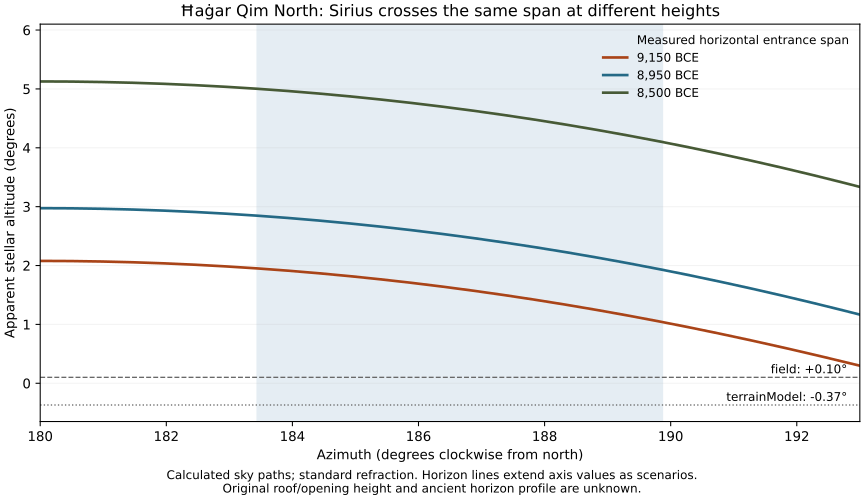
The two-century replacement claim is not demonstrated by the horizontal opening. The calculated midpoint height rises from 1.60° apparent to 2.50° in 200 years. A sufficiently low lintel or other obstruction could remove the star from view; a taller opening would not. The loss date therefore remains null. Nor have we reproduced Reedijk’s original software configuration: the public account does not provide the complete input settings. [S356 · Reedijk, L. (2019)]
Visibility also depends on the air. At 9150 BCE, illustrative extinction coefficients of 0.2 and 0.3 magnitudes per airmass yield midpoint magnitudes about +2.95 and +5.12, respectively. Toward the western edge, the hazier case reaches approximately +6.39, beyond the illustrative sixth-magnitude limit. Thus a geometric passage does not mean the whole track was readily visible. These are dark-sky scenarios, not a palaeoclimate reconstruction or a calculated heliacal-rising date. At 9400 BCE the modeled midpoint is substantially more sensitive to extinction, so this work does not verify an exact first-visibility year. [S357 · Silva, F., and Lomsdalen, T. (2025)] [S361 · CDS SIMBAD. Sirius: ICRS J2000 position, proper motion, parallax, radial velocity and V magnitude; astrometry attributed to van Leeuwen (2007)] [S364 · Kasten, F., and Young, A. T. (1989)]
Proper motion matters: suppressing it puts Sirius below the geometric horizon at the entrance midpoint in 9150 BCE. Removing radial velocity alone changes the calculated height by about 0.10°; moving latitude by 0.01° changes it by about 0.01°. Nutation, annual aberration/parallax, binary orbital motion and Galactic acceleration are not modeled. The catalog motion is propagated as constant space velocity, not treated as a precision 11,000-year stellar orbit. The calculation is appropriate for testing the broad geometry, not assigning a narrowly dated construction event.
Tracing the archaeological date
The citation chain now reaches Silva and Lomsdalen’s Supplementary Table S3 → Evans (1971), pp. 88–90. Those Evans pages were not obtained in this review. The supplement’s Tarxien assignment must consequently remain source-attributed, rather than a verified reading of an excavated construction deposit. A second primary scholarly catalogue records Ġgantija as North’s earliest material; these statements cannot be silently merged into one construction date.2
The original Ashby, Bradley, Peet and Tagliaferro (1913) report was recovered. On pp. 70–71 it describes investigating the southern room of building N, recovering pottery and reaching bedrock 0.30 m below the earlier excavation level. It does not identify that short passage as a sealed foundation deposit with a direct age. Its detailed torba-floor sequence immediately before this passage belongs to building W, and must not be transferred to North. Matching historical N to the exact modern survey footprint still requires the original labelled-plan crosswalk. [S365 · Ashby, T., Bradley, R. N., Peet, T. E., and Tagliaferro, N. (1913)]
On pp. 73–74 the excavators explain that earlier clearance had displaced and discarded material, limiting pottery-based ordering of individual parts of the complex. That is a documented provenance problem, not evidence that all associated pottery is intrusive or that the stones must be millennia older. No secure North-specific initial-construction assay was identified in the sources inspected. [S365 · Ashby, T., Bradley, R. N., Peet, T. E., and Tagliaferro, N. (1913)]
Honest label: “Neolithic archaeological attribution; the precise initial phase and construction-context chain require verification. Proposed 9150 BCE Sirius date is not an independently established building age.”
Does the proposed building order work?
Proposed dates below are transcribed from Barratt’s literature table, which attributes the Sirius interpretation to Reedijk; the complete book calculation table remains uninspected. These are an audit of published predictions, not new astronomical fits. “Earlier” refers to construction order, not merely which building contains older pottery. For Mnajdra North, the printed entry is “Sirius (7950)”; BCE is inferred from the surrounding entries and this convention is recorded in the ledger. [S358 · Barratt, R. P. (2022)]
| Comparison | Published Sirius sequence | Archaeological order / evidence | Assessment |
|---|---|---|---|
| Ġgantija | North 5350 BCE → South 4250 BCE | Heritage Malta’s curator identifies South first, then North. | Reversed. The larger South also precedes the smaller North. [S337 · Bugeja, W. J. (2020)] |
| Skorba | East 8750 BCE → West 5300 BCE | The original 1962 report says East was built against West, removing and incorporating parts of its wall. | Reversed at a reported physical contact. See the original construction audit. The full 1966 monograph remains unaudited. [S369 · Museum Department, Malta. Report on the Working of the Museum Department for the Year 1…] |
| Ta’ Ħaġrat | Small/East 8800 BCE → Main/West 4700 BCE | Museum account calls East probably later than West. | Reversed, with the archaeological order itself qualified. [S367 · National Museum of Archaeology, Malta. The Megalithic Temples of Malta. Google Arts & C…] |
| Mnajdra | North/East 7950 BCE → Central 6100 BCE | Archaeological synthesis places Central last. | Compatible partial order, not validation of either absolute date. The South-before-Central structural contact is independently described, but no Sirius date for South appears in the compared table. [S87 · Heritage Malta. Ħaġar Qim and Mnajdra: archaeological description in institutional news.] [S358 · Barratt, R. P. (2022)] [S367 · National Museum of Archaeology, Malta. The Megalithic Temples of Malta. Google Arts & C…] |
Trump additionally infers that Skorba East went out of use before West; his later account calls this a hint, based on East’s rubbish deposit preceding its roof fire. Overlapping occupation is therefore kept separate from the observed deposit sequence. [S371 · Trump, D. H. Xewkija and elsewhere: new thoughts on old sites. Malta Archaeological Review 8 (issue labelled 2006/2007; volume copyright 2011)] This does not rule out changing astronomical practices, but it works against treating every newer temple as the replacement of an unusable older one. The 2025 prose/table tension over Skorba’s phase is retained in the evidence ledger rather than silently corrected. [S366 · Trump, D. H. (1981)] [S357 · Silva, F., and Lomsdalen, T. (2025)]
These selected, source-traceable pairs are not an all-temple statistical test. Absolute ceramic chronologies could shift without reversing a secure physical building order; that makes relative order a useful independent test of the proposed dates. A revised hypothesis involving earlier structures followed by Neolithic rebuilding would need evidence identifying which walls or openings survive from each episode. Later reuse cannot simply be assumed whenever a prediction disagrees.
What would change the assessment
The highest-value remaining North records are Evans pp. 88–90 and the labelled plan/finds crosswalk. The Skorba follow-up has now recovered the original 1962 report of the West/East wall relationship, supporting the sequence reversal independently of calendar dating. The full 1966 monograph and plans remain useful for checking the precise contact and later use history. A surveyed azimuth-by-altitude profile from the same observation point, with defensible doorway/roof reconstruction, is required to calculate a complete visibility window. Until then, keep construction age, first visibility and loss of view unassigned.
Reproduction files: scripts/model-hagar-qim-sirius.py; research/data/malta/hagar-qim-north-sirius-inputs.json, hagar-qim-north-sirius-results.csv, hagar-qim-north-sirius-checks.json, and hagar-qim-north-sirius-evidence.json. Run with Python, PyERFA 2.0.1.5, NumPy, SciPy and Matplotlib. The script checks an ERFA published benchmark and compares its horizon geometry with ERFA’s separate hour-angle transformation. These checks validate implementation consistency, not archaeological intent or dating.
Return to the Malta research index · Sea level and past coastlines · Locate this record
Footnotes
-
Reedijk’s 2019 essay describes Sirius returning to visibility around 9400 BCE and the North Temple alignment around 9150 BCE; her book-summary page instead gives about 9150 BCE for renewed visibility. These source formulations are preserved, not reconciled by an independent visibility calculation. [S356 · Reedijk, L. (2019)] ↩
-
S357 Tables 2/S3 assign North to Tarxien, citing Evans 1971 pp. 88–90. Trump’s 1981 appendix lists North as five-apse, with Ġgantija in a column headed “Earliest material”, not “construction date.” Older material may be residual, or the phase classification may differ; neither explanation is established here. The original Evans passage and context linkage are still required. Neither entry independently supports a Mesolithic construction date. [S357 · Silva, F., and Lomsdalen, T. (2025)] [S366 · Trump, D. H. (1981)] ↩